Tuesday, January 24, 2012

And the Answers Are…..

Of course the first thing that comes to mind when you think of a fish hatchery is, well fish! But did you know that the hatchery plays host too many other critters besides the salmon and steelhead we produce? Here are the answers to last Friday’s quiz:
1)      Belted Kingfisher
2)      Mink
3)      Mallard duck
4)      Osprey
5)      Great blue heron
6)      Sculpin
7)      White tail deer
8)      Northern (red-shafted) Flicker
9)      Common Garter Snake
10)   Grey squirrel
Some of these critters are attracted to the hatchery because of the fish. Others find our ponds to be a great place to take a rest. Many consider the hatchery a part of their home range, nesting in the trees and grazing on the lawns. Some amazingly make it in through the water intake system or are dropped by avian predators. We do our best to keep the predatory critters away from our fish. While one kingfisher wouldn’t make a large impact on the fish it can spread disease (see Tracks in the Snow). However our animal friends get here we welcome them and hope to see them often. Well, as long as they play nice with our fish…..

Friday, January 20, 2012

Quiz: Name the Top Ten Non-Salmonid Critters Seen at Dworshak

Here are photos of the top ten animals we see at Dworshak National Fish Hatchery.
Can you name them all? Use the comment box to record your answers. 


Answers will be posted Tuesday 1/24.
Good Luck!

Wednesday, January 4, 2012

Steelhead Spawning, Take 1

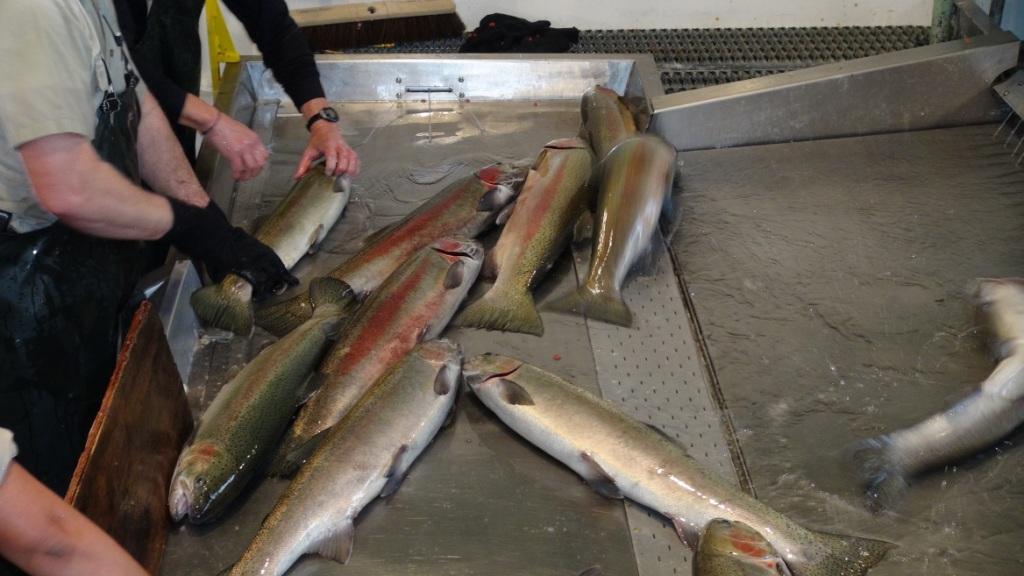
It is a new year and we are welcoming a new brood of steelhead to Dworshak National Fish Hatchery. Today, January 4th, was our first “take” of the 2012 steelhead spawning season. We successfully paired 66 females with 54 males to fertilize approximately 442,000 eggs! Volunteers, students, and employees from IDF&G pitched in to help Dworshak Fisheries Complex employees work through a total of 438 steelhead.  There is always a lot of fun and enthusiasm on the spawning floor, especially on the first take of the season. Having healthy fish return to the hatchery to spawn affirms all the hard work we do at the Hatchery every day.
 

A table full of steelhead being checked for ripeness.


The spawning process is somewhat like a balancing act. We have to make sure we spawn an equal, or close to equal, number of males to female so no fish goes to waste. Typically we start by spawning males as a very ripe male can be used to fertilize the eggs from two females. A problem we sometimes encounter is males and females ripening at different rates. Female steelhead often ripen before males, and if there is no milt to fertilize the eggs we lose progeny. As an insurance policy we inject some of the males with a hormone to help them mature. This is done by staff from the Idaho Fish Health Center about two weeks prior to the first spawning.

USFWS employee, Clarice Holt, returns a "green" steelhead to the holding ponds.

Once we spawn our males we begin collecting eggs from female steelhead. Like the males, if a female is not ripe she is put back into our holding ponds and will be spawned in a few weeks. As soon as eggs are taken from a female both eggs and milt are carried to the incubation room where the eggs from one female are paired with the milt from one male. A saline solution is added to the eggs and sperm to activate the sperm and aide in fertilization of the eggs. The mixture is swirled around, and fertilization takes place in less than one minute.  After fertilization the eggs are rinsed to remove excess milt and any blood or egg shells, and then the eggs are placed in their own individually numbered tray for incubation. The eggs that were fertilized today are already beginning to develop and will be at the eyed stage in 3 to 4 weeks. They will hatch in about 6 weeks and will begin to feed in about 10 weeks. By early May the eggs we fertilized today will be about 3 inches long and will see their first sunlight as they are ponded into our outdoor burrows ponds. By May 2013 these fish will be experiencing their first taste of freedom as they make their way down the Clearwater River, into the Snake, and ultimately to the Pacific Ocean where they will spend 1-4 years before returning to the Hatchery.
Mixing milt into eggs


Brood year 2012 is off to a great start! We will continue spawning steelhead on a weekly or bi weekly schedule until we reach our egg take goal of 2.5 million eggs. A new year is a time to look forward and we are certainly looking forward to welcoming a new brood of healthy fish to the Hatchery!


Friday, December 30, 2011

Tracks in the Snow


After a cold and snowy day at the Hatchery, the crew arrived the next morning to find evidence of an overnight visitor.  The oversized tracks were nearly as long as a human foot and eerily resembled what a Tyrannosaurus Rex might have looked like.  Fortunately, this was not a T-rex, but rather a relatively common Great Blue Heron, Ardea Herodias.  One could imagine this tall bird walking along the perimeter of the Hatchery peering into what must be a heron Shangri-La;  2.1 million budding steelhead smolts at just the perfect snacking size.  Unfortunately, for the Hatchery’s guest, the bird netting was an effective deterrent and the tracks never re-appeared within the confines of the fish production area. 

The tracks were a reminder to the constant vigilance the Hatchery crew maintains to repair netting and keep the area predator free.  A Great Blue Heron does not eat that many fish as compared to the millions of smolts supported at the Hatchery.  However, a larger problem occurs by the transfer of smolts and water across rearing containers.  The transfer issue can cause disease contamination.  In the Hatchery setting, disease prevention is the best cure.  One transfer of a virulent disease can cause substantial fish losses.  In the past, the Hatchery has encountered infections of Infectious Hematopoietic Necrosis (IHN) that has caused mortality rates of over 50%!  So despite, the Great Blue Heron’s regal stature and fit into the natural ecosystem, he is an unwelcome guest here at the Hatchery.  We wish him luck on his hunting adventures as long as they aren’t here!

The following photos are from the William L. Finley National Wildlife Refuge in Benton, OR.

Photo credit: George Gentry/USFWS


Photo credit: George Gentry/USFWS


Thursday, December 22, 2011

Hatchery Technology Improvements

Dworshak Hatchery has a new chiller.  The chiller is used to cool water used to incubate Chinook salmon eggs in the incubation room (See December 9 posting).  This chiller replaces the original chiller which dates back to the 1980’s.  The old chiller was barely running and was only able to chill the water a few degrees.  Our new chiller is taking incoming water at 44 degrees and chilling it to 36 degrees.   Without the chiller, the incubating eggs would have hatched long ago and would need to be placed in rearing tanks soon.  Since there is no space for the small Chinook salmon right now, this would be a huge problem.  With the chiller operating, the juvenile Chinook will not need to be placed in rearing containers until April.  Last years’ Chinook salmon will have been stocked by then and the Chinook raceways will be empty and ready for another production cycle.
Dworshak's new water chiller, pre-installation

The new chiller is a significant technology advancement over the old chiller.  It is easier to program, utilizes less power to run and occupies a smaller footprint.  Eventually, the waste heat from the chiller will be tapped to heat one of the buildings.  This will save even more energy helping to meet the government's initiative to decrease power consumtion and be more green.

Monday, December 12, 2011

Northwest Fish Culture Conference

Armed with fresh passports, several members of our hatchery crew eyed the border guard with uncertainty.  However, with a friendly "Where you headed, eh?", we were cleared through customs and headed to Victoria, British Columbia to attend the 62nd Northwest Fish Culture Conference.  This conference is a joint venture of States, Agencies, Tribes, Private ventures, and Provincial governments concerned with fish culture in the northwest.  Victoria's inner harbour provided a tremendous backdrop for the venue at the Historic Fairmont Empress Hotel.

Victoria's Inner Harbor
The view was complete with a festive decoration of the Parliament building and several totem poles honoring the traditions of this unique area.  Since many of the programs in the Pacific Northwest are closely tied to salmon and trout species, Victoria provided a great host for this venue.

A festively-lit Parliament Building, in Victoria, BC
Totem Pole
Of course, the conference was front and center stage.  The agenda covered a great depth of discussions ranging from New Investigational Animal Drugs to recirculating aquaculture systems and survivability issues in triploid salmonids.  The hatchery staff members spent their days scribbling notes and tracking down the latest innovations in the business.  After-hours were spent with old friends and new acquaintances.

The crew also took an impromptu field trip to the Vancouver Island Trout Hatchery to look at some retrofitted partial re-use systems.  These systems used an airlift pump to circulate, strip carbon dioxide, and re-oxygenate the water.  With this system, the Vancouver Hatchery was able to reduce water usage by almost 70%!  Despite the cold temperatures (-4 C), the Dworshak crew was excited to brainstorm ideas on how this could be applied in the future on the short trip back from Duncan to Victoria.


A tour of Vancouver Island Trout Hatchery

Time flew by during our visit and before we knew it, we were headed back to the hatchery re-invigorated with new ideas to solve the never-ending myriad of fish culture challenges we face daily.  How bout' that, eh?

Friday, December 9, 2011

The Pitter Patter of.....Little Fish!

Within the cold, dark Heath trays of Dworshak’s incubation room an exciting transformation is taking place. Eggs that were spawned from returning Chinook salmon last August are beginning to hatch. Alevin, or yolk bearing fish larvae, are breaking free from their shells and beginning their first stage of life as fish. Although free from the confines of the corion, or egg shell, alevin are quite limited in mobility and still depend on their yolk sac for nutrition. In the wild alevin remain in the shelter of the gravel redd for several weeks after hatching. Once most of the yolk sack is absorbed the tiny fish will emerge from the gravel as fry, about 1 inch long.
Stacks of Heath style incubators stand like soliders in Dworshak's incubation room.

At the hatchery, alevin remain in the safety of their Heath trays making a slow but steady transformation from larvae to fry. Newly hatched Chinook have many developmental milestones to reach before they can survive life outdoors.  Just after hatching these tiny alevin don’t appear very fish like. Externally their fins will continue developing over the next few weeks and internally their digestive system has yet to form completely. 

Newly hatched Chinook alevin hardly resemble fish...


...but in a few months they will look like this!
 
Temperature plays a huge role in the rate at which salmon develop. The ideal rearing temperature for Chinook salmon from egg to fry is about 8 °C (46.4° F), but rearing temperatures can range from between 4-12° C (39-54° F). A rule of thumb is the colder the water the slower development will be. In fact it is common practice in aquaculture to use temperature units (TU) to estimate the critical stages of egg and fry development.  One TU is equal to one degree Fahrenheit above 32° F for every day of incubation. So under an ideal rearing temperature of 46° F Chinook salmon gain 14 TUs a day. In general, Chinook salmon eggs reach the eye up stage at 450 TUs, will hatch at 750 TUs, and will emerge around 1600 TUs.
Eyed Chinook eggs with a few newly hatched alevin

The 2011 brood year of Chinook salmon are at about mid-hatch and will continue their exciting, yet inevitable transformation into tiny fish. The majority will grow up strong and healthy at the hatchery and enter the Clearwater River in the spring of 2013. It is amazing to know that many of these fish will survive and live in the ocean for as much as 5 years; but like their parents before them instinct, determination, and good fortune will direct them back to Dworshak where they will pass along their legacy to the next generation of Chinook salmon.